Navigate between sections by clicking the arrow icon on the right. The page is auto-translated. Minor translation errors may occur.
Welcome to Why ACIP
This is a campaign page highlighting the injustice of Parker's new bonus system ACIP.
This page may be the only attempt to influence ACIP. The company is happy if everything is calm and quiet around ACIP and IF Metall shows no signs of wanting to do anything.
Are you blue‑collar worker happy with ACIP? Do nothing. If you want to try to be involved and have an impact, then you have to get involved.
A lonely pensioner against a large global corporation
My name is Hans Öster and I have almost 30 years of employment at Parker's manufacturing unit in Borås behind me. During all my years as an employee, I have been union active, including as chairman and member of IF Metall's workshop club. Today I am 68 years old and retired on February 1, 2026.
I created this site entirely by myself using Joomla. I had no previous experience building websites, and although it wasn't exactly easy, most things are possible if you have the will.
The main issue I want to raise is serious
Should American values be allowed to destroy the Swedish model, which is based on justice and equal treatment?
I have already contacted several Swedish media outlets regarding the introduction of ACIP, and I will also be reaching out to American media outlets.
Your help is crucial!
This project is David's fight against Goliath. But David is not alone if you who work on the floor get involved.
A campaign page fades quickly if visitors are passive. For us to succeed, it is crucial that you:
- Write comments and posts on this page.
- Spread the link to the page in all channels you can.
Together we make a difference!
You can write your posts and questions here in the contact form.
If you want to read incoming posts and questions, do so on the notice board.
/ Hans Öster
Parker Hannifin AB changed its bonus system in 2022 from the fairly equal RONA system to ACIP, which gives white-collar employees twice as high a bonus percentage as blue-collar workers.
After 10 years, a white-collar worker has received around SEK 300,000 more in bonuses than a blue‑collar worker, and he has also increased his annual salary during the same period by around SEK 22,000 more than a blue‑collar worker.
Go to the bonus calculator for more accurate numbers and to test different scenarios.
Jennifer A. Parmentier and ACIP
 AI-generated image
 Jennifer A. Parmentier is currently Chairman of the Board and Chief Executive Officer of Parker Hannifin Corporation. She became Chief Operating Officer in 2021, with responsibility for all of the company's operating groups. In 2023, she assumed the role of CEO and in 2024, she assumed the role of Chair of the Board.
ACIP was introduced in 2022, before Parmentier became CEO. However, as COO, she played a central role in the company's operational management and thus in supporting and implementing the new system as it was rolled out globally.
ACIP means that blue-collar workers receive a target percentage of 5%, while white-collar workers receive 10%. This is a clear shift from the previous, more equal RONA system and has created increased differences between groups that both contribute to the company's results.
Her compensation
According to public data from www.salary.com, Jennifer A. Parmentier's total compensation for fiscal year 2025 was: $19,317,705
With the exchange rate of 1 USD = 9.22 SEK, this corresponds to approximately: 178.2 million SEK. This is a compensation level that naturally raises questions about fairness and priorities when the target percentage blue-collar workers is simultaneously half that of white-collar workers in the new bonus system.
To put the amount in perspective: A Swedish blue‑collar worker employed by Parker earns around 35,000 kronor a month, or 420,000 kronor a year. Parmentier's total compensation therefore corresponds to the annual salary of approximately 425 blue‑collar worker .
Five of Parker Hannifin's top executives have a combined total annual compensation of $45,437,244, which is equivalent to approximately 419,000,000 Swedish kronor. This is equivalent to the salary of 997 Swedish blue‑collar worker .
Salary information can be found on this page.
Reflection
Although Parmentier was not ultimately responsible when ACIP was introduced, as COO and later CEO, she has played a significant role in maintaining and supporting a bonus system that gives white-collar workers twice the target percentage as workers.
When management compensation is at very high levels, a natural discussion arises about how the value of different professional groups is assessed within the organization.
As the current top manager, she has both the opportunity and the responsibility to shape a bonus system that is perceived as fair by all parts of the company.
Was RONA a fairer bonus system?
For many years, RONA was the bonus system that applied to Parker employees in Sweden. It was based on a simple principle: everyone received the same bonus percentage, regardless of whether they were blue‑collar worker or white-collar worker. Only higher up in the management ranks did the bonus begin to be multiplied by factors such as 2, 3 or 4, which in itself is not uncommon in larger organizations.
The basic idea was still clear – the vast majority worked towards the same goal and were rewarded in the same way.
The system was not perfect. Since white-collar workers generally have higher salaries, the same percentage meant that they received more money in absolute terms. But despite this, RONA was perceived as significantly fairer than ACIP. It created a culture of helping each other across departmental boundaries, because everyone knew that the bonus was shared and based on a collective result.
The contrast with ACIP is clear. Where RONA held the organization together through a common percentage, ACIP divides it into two groups: white-collar workers at 10% and blue-collar workers at 5%. It’s a difference that’s felt directly in the wallet and affects how people experience their role in the company.
It is important to emphasize that this description applies from a Swedish perspective. I have no insight into how RONA was applied in other countries or what local agreements looked like. But for the Swedish workers, RONA was a system that was experienced as more egalitarian, more cooperative, and more in line with how justice is traditionally viewed in industry.
Does ACIP increase engagement among all employees?
Is ACIP really a bonus system that strengthens the sense of fairness in the business? Or does it risk being perceived as an insult to the blue-collar workers who have done their utmost to meet the company's demands for productivity, quality and flexibility over the years?
Can we expect commitment when those closest to production — those who have always put in overtime, solved problems, improved flows, and carried the business through tough periods — are suddenly faced with a system where their efforts are valued less than those of white-collar workers?
What signals does it send when you go from a previous bonus system, which was perceived as fairly equal (RONA), to a new system where white-collar workers receive twice as high a target percentage? What does it do to the sense of justice? What does it do to motivation? What does it do to the pride in the work you do every day?
Is it reasonable that those who work in the workshop — those who actually produce the value — should feel less important than those who work in the office? And how does this affect the relationship between the groups when the differences in bonuses can no longer be explained in a way that feels fair?
Can a bonus system that is perceived as unfair really create engagement? Or does it instead risk creating disappointment, frustration and a feeling that loyalty and hard work no longer matter?
An ACIP guarantee to blue-collar workers
Is an ACIP guarantee really a benefit to blue-collar workers?
On paper, of course, it sounds good: if the company does not reach the goals set by management, and no bonus is paid, the blue-collar workers will still receive a 2.5% guarantee.
How often does the situation where the guarantee is activated actually occur? Can several years pass between each occasion? And what happens in the meantime — when, year after year, white-collar workers receive significantly higher bonus payments than blue-collar workers?
Is the guarantee then a benefit or more like a meat bone thrown to workers to alleviate the sense of injustice that arises when the target percentages are so different between groups?
Does management believe that workers are so gullible that they see the ACIP guarantee as a major benefit?
If you think a step further: Is this even a situation that you, as a blue‑collar worker want to end up in? What does it mean for the company when no goals are achieved and no bonus is paid? Could this indicate that the business is in a financially strained situation? If profitability is declining — what costs do companies usually start to review first?
In such a situation, could there be a risk that the workforce will be affected? Could blue-collar workers be the ones hit hardest when costs are reduced?
If so, what value is there in a guarantee that is only activated in a scenario where no one really wants to be?
Can such a guarantee really be perceived as fair, or will it become yet another reminder of how differently blue-collar workers and white-collar workers are valued in the business?
Do Americans control Swedish companies in detail?
Is it really the Swedish management that controls the business — or is it in practice the American management that makes the crucial decisions?
When RONA was the prevailing bonus system, Swedish management stressed the importance of fairness, equal treatment and respect between groups. One manager in particular, during the RONA era, became upset when it was suggested that white-collar workers were sometimes favoured over blue-collar workers. He said: “As long as I am a manager, I will never contribute to any discrimination against staff.”
But what happened to those values when ACIP was introduced? How can the same manager — and the same Swedish management — now wholeheartedly support a bonus system where white-collar workers have a target percentage of 10% and blue-collar workers only 5%? Has anything changed in the view of fairness? Or is something else at play?
How much autonomy does the Swedish management really have? Can they invest the profits generated in Sweden without first asking for approval from the US? Can they hire without asking? Can they give salary increases beyond the central part without getting the go-ahead from American owners?
And what does it mean for blue-collar workers when every extra tenth of a cent in pay increase — even in years of record profits — has to be approved by management on the other side of the Atlantic? How does it affect the feeling of being valued, seen, and treated fairly?
When ACIP is introduced with such large differences between blue-collar workers and white-collar workers — is it an expression of Swedish values? Or does it reflect an American view of hierarchy, status, and the value of different professional groups?
Could it be that the Swedish leadership really has no choice? That they can only follow the guidelines that come from above, even when they go against the Swedish tradition of justice and equal treatment?
If so, what does that mean for the future? What happens to the Swedish model when decisions about bonuses, salaries, investments and staffing are in practice made by owners who do not share the same view of equality?
It's good to have wealthy owners. It's not as good when they transfer their values to Swedish companies.
Are blue-collar workers satisfied with how ACIP is designed?
5% target bonus for blue-collar workers and 10% target bonus for white-collar workers. Do you think that is acceptable? Then there is not much more to think about. If there is still dissatisfaction with the new bonus system, there are things that can be done.
Did those managers, especially American ones, who believe that the design of ACIP will increase the commitment of all employees, skip the psychology courses in their training?
 AI-generated image A direct question to Jennifer Permentier - Parker's top leader -. Do you think the design of ACIP where white-collar workers receive significantly higher bonuses than blue-collar workers will lead to increased blue-collar worker engagement?
Respond via the contact form and I will publish your answer here.
If the white-collar workers are the brains and the blue-collar workers are the heart, it is worth remembering that neither works without the other.
Blue-collar workers do their jobs. They keep production going. But commitment isn't something you can command—it's something you earn. When a company clearly signals that some groups are more valuable than others, the willingness to take on extra responsibility decreases. It's a natural reaction.
It's no wonder that improvement efforts, initiative, and loyalty begin to wane. Why would you invest energy in creating profits that ultimately reward others more than yourself?
When motivation drops, it shows in production. Delayed orders, lower efficiency, reduced profitability — these are the things that usually wake companies up. They are the consequence of a system that does not value everyone equally.
What can the union do?
If change is to be achieved, blue-collar workers must start by putting pressure on the local union to do something to change ACIP. Don't accept the answer "we can't do anything about it, it's decided globally by the American leadership, it's better we focus on things we can influence", everything can be changed, but it requires a great deal of commitment from those you have elected to the local union.
The day the union is no longer a counterpart to the Company, it has played out its role.
One way the union can act is to collaborate with the other units in Sweden to bring about a change in ACIP, another is to act so that the company understands the power that exists in the union and its members, the union has many tools they can use. Then we have IF Metall's central union, if the local union can't do anything, the union can help.
Blue-collar workers pay a high membership fee to IF Metall, make sure you get value for your money. You work to get a salary and bonus and you want a good working environment, make sure your elected officials focus on that.
Prepare before the annual meeting, sit in the coffee rooms and discuss what issues you want your local union to pursue and present your opinions at the meeting. Above all, attend the meetings the union calls.
The company
There could have been a longer text here about the company's responsibility for equal treatment and how ACIP damages their reputation. But that's not necessary.
The company's actions already show that fairness is not a priority.
ACIP is created by white-collar workers for white-collar workers. Management has chosen to implement it. There is really nothing more to say.
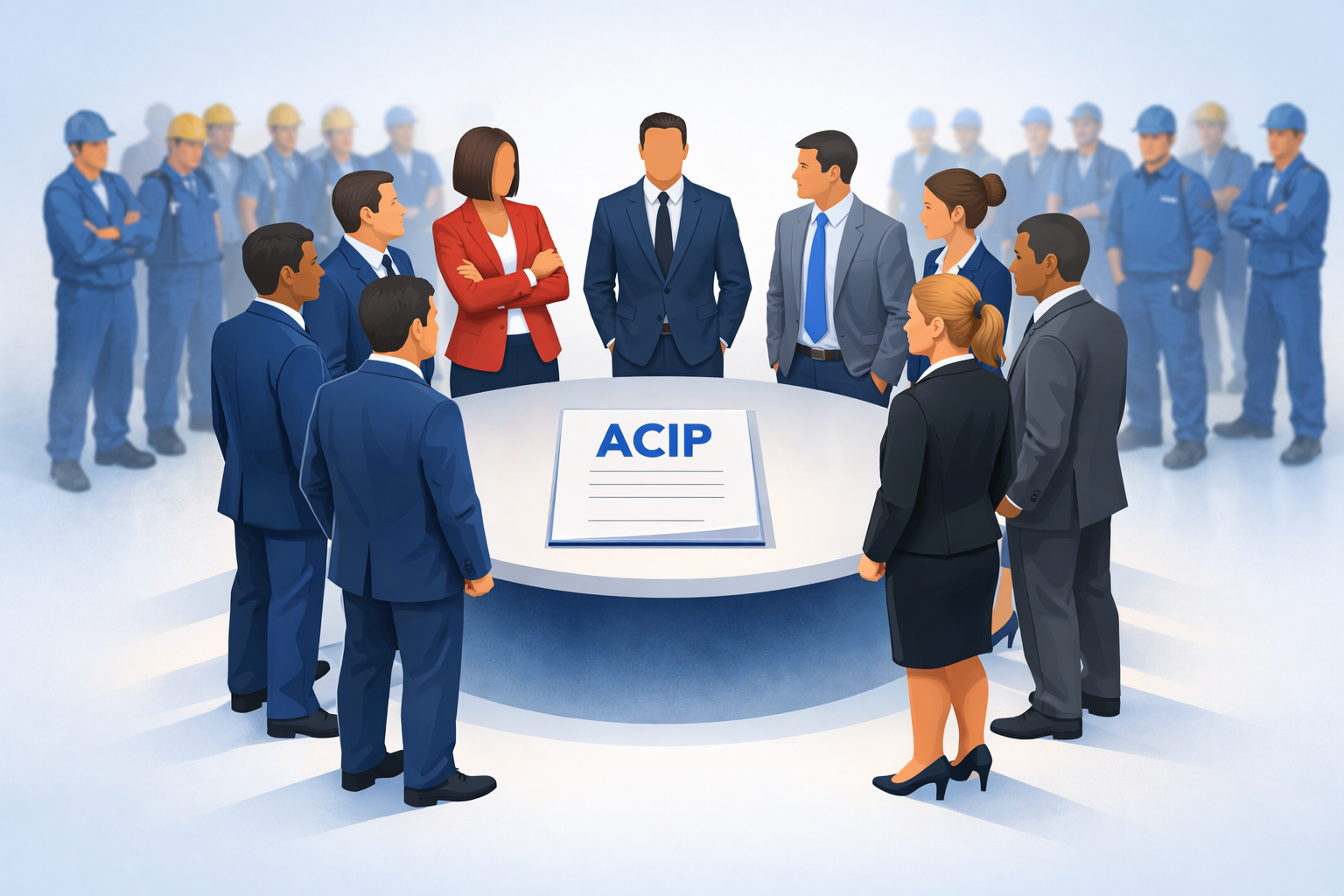 AI-generated image
This page
This page was created to give blue-collar workers a voice and to highlight the injustice that ACIP represents.
I encourage you to leave comments on the page where possible and to spread the address to as many people as possible.
The page is multilingual and auto-translated (errors may occur, please be forgiving), it is easy to add more languages if desired.
The goal is to spread the page to all Parker units around the world, I will use all channels. Regular media, social media and forums.
Keep in mind: No one can do everything but everyone can do something, so again, comment, give me news about Parker.
If you feel you have been treated unfairly by Parker, use the contact form and your experience will be published.
Use the side menu by clicking the arrow icon on the right to quickly jump between sections.